Grading Indian wedding photographs without wrecking the colour
Red lehenga, gold thread, marigold everywhere, and skin that has to stay believable through all of it. What actually works, and what to avoid.
18 October 20267 min read
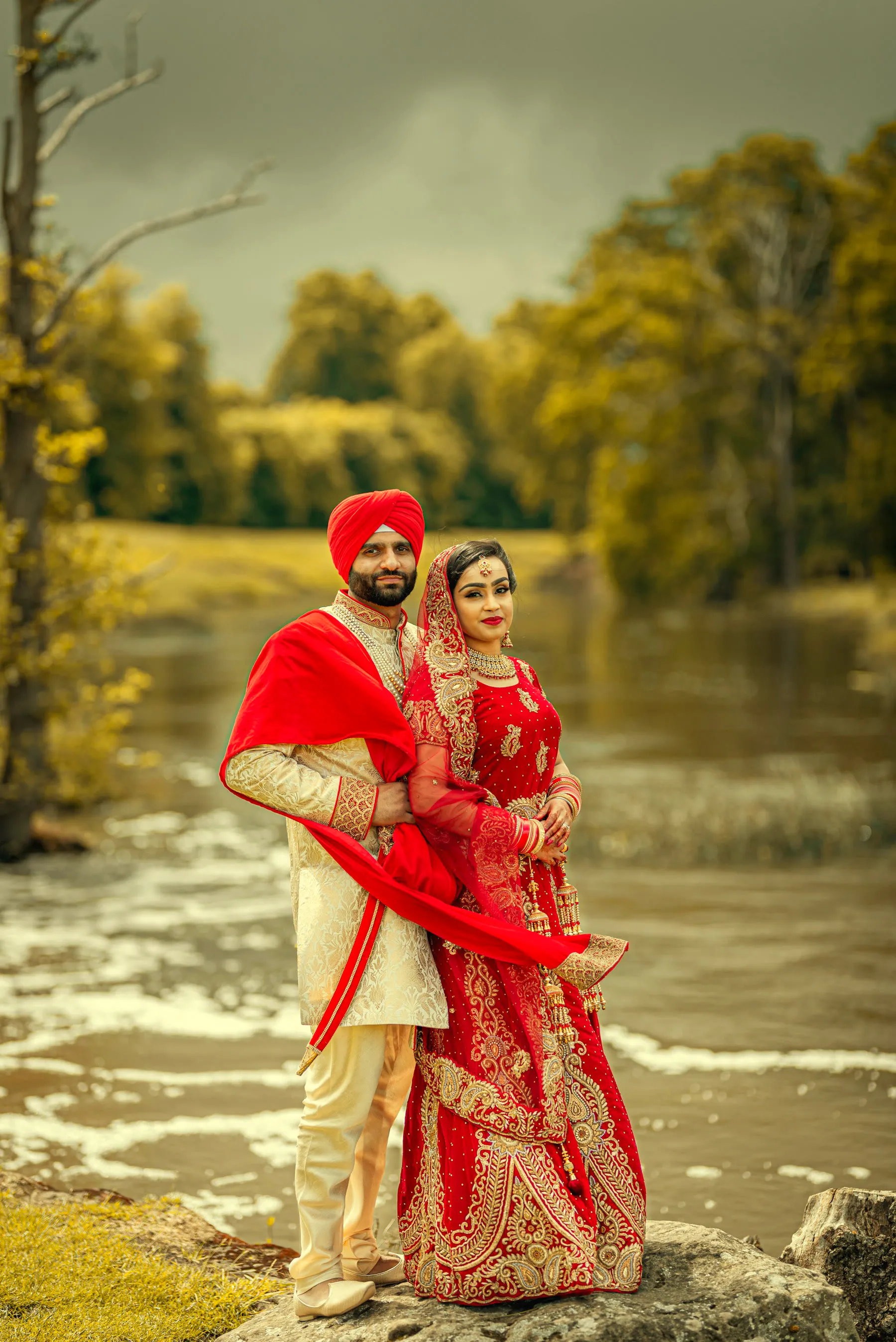
Indian wedding frames arrive at the edit already loud. That is the point of them. The grading problem is that most warm presets were built on Western wedding photography, where the dominant colour is white, and they fall apart the moment the dominant colour is saturated red.
What goes wrong
Red blocks up. A warm grade that pushes the red channel hard runs a saturated lehenga straight into clipping. The fabric loses its folds and becomes a flat red shape. This is the single most common failure.
Skin follows the fabric. Push warmth globally and faces go orange along with everything else. Skin and fabric occupy overlapping ranges, so a blunt warm push cannot separate them.
Gold goes green. Gold thread sits in a narrow band of yellow. A grade that shifts yellow toward green for “film” character turns zari dull and slightly sick.
Mixed light across the day. Open daylight for the baraat, deep shade under the mandap, tungsten and flash at the reception. One grade applied flat across all of it will not hold.
What works instead
Cap the red channel. The curve should lift red through the midtones and then flatten near the top. That keeps the warmth while leaving headroom so saturated fabric retains detail. You can see this shape plotted on the Haldi pack page, red rises through the middle and then runs almost flat into the highlight.
Drop blue in the midtones only. Pulling blue down in the midtones warms the ambient light without dragging skin with it, because skin’s warmth lives higher up.
Leave yellow’s hue alone. Shift its luminance if you need to, not its hue. Gold is a hue, and moving it is what kills zari.
Grade per lighting situation, not per wedding. Three or four grades across a day, not one. Open daylight, shade, tungsten, flash. Within each, one grade and per-frame exposure.
The working order for a wedding set
- Cull hard, then group by lighting situation rather than chronologically.
- Within each group, neutralise white balance on one representative frame and sync it.
- Apply the grade for that situation across the group.
- Per-frame exposure only.
- Pull the skin-safe variant for close portraits.
Grouping by light rather than by time is the move that makes the rest fast. Done chronologically you are switching grades every few frames.
On skin specifically
Most packs built for this subject include a skin variant, and it exists because close portraits need less of everything. Our Haldi pack puts them at the end of the list for that reason.
When a face occupies more than about a third of the frame, start from the skin variant rather than correcting the full-strength one down.
Testing before committing
Do not grade two thousand frames on the strength of a sample image. Put the grade on five of your own frames first, one in sun, one in shade, one close portrait, one wide, one at night.
You can do that in the browser at the test bench without buying anything, or without uploading anything anywhere.
Written by the Graded By colour lab. Every pack ships both the desktop and the mobile preset file, plus this guide in print.